Guide
Sub-Zero Freezer Not Working: Symptom-by-Symptom Checks
When a Sub-Zero freezer quits, the cause is almost always one of five things: a clogged condenser that keeps the compressor from shedding heat, a door or drawer that is not closing tight, frost smothering the evaporator coil, a failed fan or temperature sensor, or a fault in the sealed refrigerant system. The first three you can check yourself with a flashlight and a vacuum; the last two need a technician with gauges and parts. Start with the display, because on most current models it tells you which direction to look, then work down the list below in roughly the order these failures show up. In Point Loma, where salt air drifts in from the Pacific on one side of the peninsula and from the bay on the other, the condenser deserves more attention than the owner's manual gives it.
Rule out a setting or Showroom Mode first
Before assuming a part has broken, confirm the freezer is actually being asked to freeze. Classic (CL) and Designer (DET, DEC) controls leave the factory set to 0°F (-18°C) for the freezer and 38°F (3°C) for the refrigerator, and the freezer can be moved anywhere from -5° to 5°F one degree at a time, so a freezer that someone bumped to the top of that range will keep ice cream softer than you expect while doing exactly what it was told. The more confusing case is Showroom Mode, a demonstration setting in which the panel works normally but the unit does not cool. On current Classic and Designer models, a display that reads 38° and 0° while the food is plainly warming may mean Showroom Mode is on, and Sub-Zero's advice there is to phone its customer care line. A Classic (BI) spells it out as Sh r on the display, and you can leave the mode yourself:
- press Power to turn the unit off
- press and hold a matching Warmer and Colder key pair
- press Power while still holding that pair, then release all three keys
Read the code or message on the panel
If the settings look right, the panel is your next clue. Sub-Zero's electronic controls log faults and flag them with short codes or plain words, and each one points down a different branch of the problem. Write down what you see, including whether it is steady or flashing, before pressing anything, because clearing a code too soon erases the most useful evidence a technician will have. A chiming Classic (BI) can be quieted by holding ALARM and POWER together and letting go of both in less than 5 seconds, but that only hides the warning for 24 hours and repairs nothing.
- EC40 with Service flashing on 600 and 700 Series units and the 648PRO: the freezer compressor has been running far too long; the usual culprits are a door that did not latch, a fan or sensor that has quit, or trouble inside the sealed refrigerant circuit
- Service flashing between the two zone temperatures on 600 and 700 Series panels: excessive compressor run; if both readings are close to normal, clean the condenser and switch the home breaker off for 30 seconds
- Vacuum Condenser flashing: the unit is working inefficiently or running warm because of a dirty condenser, a door seal problem or a fault inside the unit; clean the condenser, then turn the unit back on to reset the message
- EE with Service (600 Series) or the wrench (Classic BI) flashing: a faulty thermistor, the freezer one when EE shows on the left; Sub-Zero offers no owner fix for it, so this goes straight to service
- a flashing wrench with the alarm chiming on a Legacy Classic (BI): a major fault has been stored, whereas a steady wrench with chiming marks a minor fault that is not threatening temperatures
Freezer warm, refrigerator fine, or the reverse
This split is how most owners describe the trouble, and it narrows things down nicely. Many Sub-Zero built-ins cool the freezer and the fresh-food side with separate systems, each with its own compressor and evaporator, so one half can fail while the other keeps running normally. A soft freezer next to a cold refrigerator therefore points at something belonging to the freezer alone: its door or drawer seal, frost on its coil, its evaporator fan, its sensor or its compressor circuit. It seldom means the house has an electrical problem or the whole appliance is finished. The opposite complaint, a refrigerator that warms while the freezer stays rock hard, follows the same logic from the other side; for that version, see our separate explainer on a warm Sub-Zero fresh-food section.
Door, gasket and drawer checks
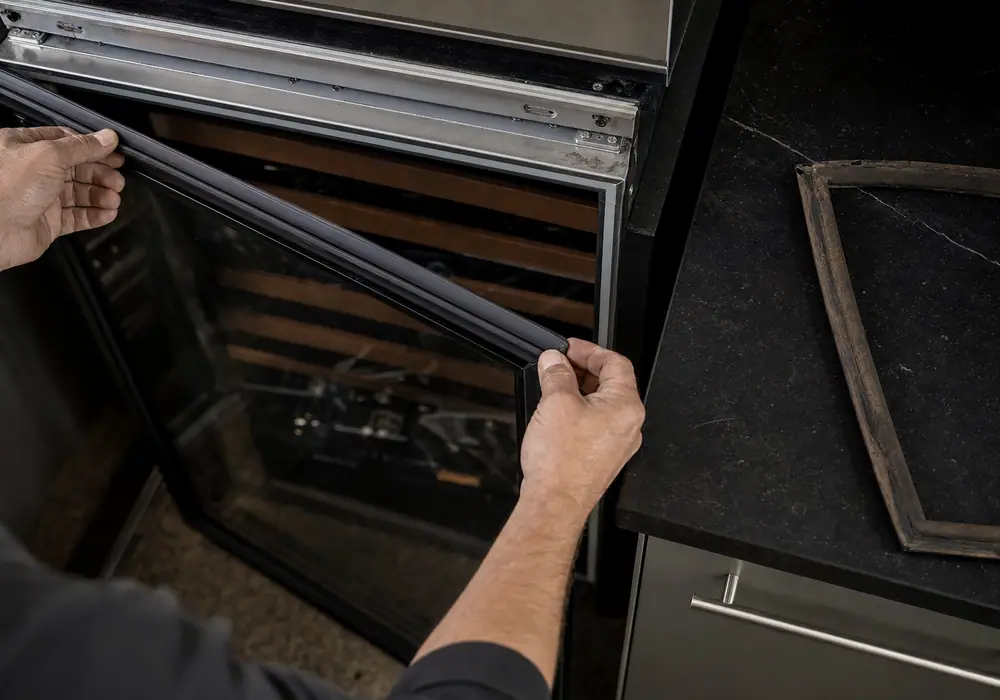
A door or drawer that is not fully sealed pulls warm, damp kitchen air in around the clock, and the compressor runs without a break trying to keep up, which is precisely the kind of overrun that sets off EC40. Freezer drawers are the usual suspects: a bag of frozen peas wedged against the back, a basket that has jumped its rails or a ridge of ice on the slides can hold the front a fraction of an inch open without anyone noticing. On Classic (CL) and Designer (DET, DEC) models, interior lights that have gone dark can be a hint, since the control turns them off when a door or drawer is left ajar to keep extra heat out of the cabinet; Sub-Zero suggests closing it and waiting one hour before you call for service.
- empty the front of the drawer and slide it fully in and out, feeling for anything that catches
- run a finger around the gasket for tears, folds or a stiff section that does not spring back
- trap a slip of paper in the closed door at the top, sides and bottom; you should feel it resist as you tug it out
- wipe frost or ice off the slides and the gasket face with a warm, damp cloth
Clean the condenser, especially near the ocean
The condenser is the radiator that throws off the heat pulled out of your food, and on a built-in Sub-Zero it sits behind a grille at the top or at the base of the unit. When lint, pet hair and kitchen dust coat it, the compressor runs longer and hotter and the freezer drifts warm. Homes in Sunset Cliffs, Ocean Beach and La Playa add salt and fine sand to that mix, and the damp marine layer helps it cling, so the coating tends to build faster than it would farther inland. Sub-Zero's own thresholds make the call simple: a unit less than 6 months old does not need its condenser cleaned yet, and when the freezer reads less than 10° above its set point, a cleaning is the right first move. There is more on how the shoreline wears on these machines on the page about Point Loma's local conditions.
- turn the unit off at its own switch or at the breaker before you start
- lift off the grille and go over the coil slowly with the vacuum's bristle tool, moving in the same direction the fins run
- never use a knife, a wire brush or a pressure washer on the fins
- restore power and give the freezer several hours to pull back down before judging the result
Frost and ice that block the airflow
A freezer that stays warm even though the compressor hums constantly may have its evaporator coil buried in frost. Air can no longer pass across the coil, so the cold stays trapped behind the rear panel while the food compartment creeps upward. Heavy frost usually traces back to a leaking seal, a door that is opened very often, or a defrost part that has stopped working, and the page on why frost keeps building up in a freezer explains each of those causes. If you need to clear thick ice yourself, the method depends on which line you own, because Sub-Zero's guides do not agree across models:
- Classic (CL) and Designer (DET, DEC): turn the unit off and melt the ice with a hair dryer on its low setting, keeping it moving
- PRO Series: use a handheld steamer instead, and keep the hair dryer away
- any model: never chip ice with a knife or screwdriver, since a punctured coil or tube turns a frost problem into a sealed-system repair
- if the frost is back within a few days, the cause has not been found and a manual defrost is only buying time
When to stop, and what to do with the food
Some failures sit beyond any owner check, and pressing on can make them worse. Call for service when the freezer stays more than 10° above its setting and no door was left open, when an EE code appears, when frost returns after a careful defrost, or when the compressor runs nonstop despite a clean condenser and sound seals; those signs point to a fan, a sensor, a defrost component or the sealed system, all of which need test equipment and replacement parts. Do not keep clearing an EC40 while temperatures are still rising, because the code is the record of what happened. While you wait, keep the doors shut: according to Sub-Zero, an empty unit without power usually needs around 3 hours before its freezer warms past 20°F (-6°C), and a packed freezer holds its cold longer than a sparse one. Our freezer and defrost repair page has the details for homes in Point Loma, Loma Portal, Liberty Station and the Midway District, or you can call (858) 375-1585.
- note any code on the panel and whether it was flashing or steady
- write down the freezer temperature and roughly how long it has been warm
- take a photo of the rating plate so the right parts can be identified
Questions
Frequently asked questions
Why is my Sub-Zero freezer not working but the refrigerator is?
Many Sub-Zero built-ins cool each section with its own system, so a warm freezer beside a cold refrigerator usually means a fault confined to the freezer side. Make sure the drawer or door closes fully, look for heavy frost on the back wall, and clean the condenser; if the freezer still sits more than 10° above its setting after that, the fan, sensor or sealed system needs a technician. Point Loma Sub-Zero Specialists answers that on (858) 375-1585.
What is the safe way to melt heavy ice out of a Sub-Zero freezer?
Switch the unit off and let the ice melt, speeding it along only the way your model's guide allows: Classic (CL) and Designer (DET, DEC) owners may use a hair dryer on low, kept moving, while PRO Series owners should use a handheld steamer and skip the hair dryer. Put towels down, never pry ice loose with a tool, and treat frost that returns within days as a sign of a deeper fault. Call Point Loma Sub-Zero Specialists on (858) 375-1585 and ask.
Why is my Sub-Zero freezer not cold enough even though it runs?
A freezer that runs but stays too warm is most often short of airflow, either across a dusty condenser or over a frosted evaporator coil. Confirm the control is near the 0°F preset, clean the condenser and check the door seal; if it is still running more than 10° warm after those steps, more adjusting will not help and the unit needs service. Point Loma Sub-Zero Specialists takes those calls on (858) 375-1585.
If it is already broken
- Refrigerator Cooling and Leak Repair
- Ice Maker and Water Delivery Repairs
- Freezer Performance and Defrost Services
- Undercounter and PRO Series Expert Repair
- Preventative Maintenance Services
- Wine Cooler Calibration and Repair
- Washer Repair
- Dryer Repair
- Dishwasher Repair
- Microwave Repair
- Oven, Range and Cooktop Repair
Appliance down in Point Loma?
Tell us the brand and what it is doing — we can usually name the likely repair before we arrive.